
News

Creating an effective portfolio: advice from artist coach Manon Taillefer
An indispensable communication tool for creative people, the portfolio is an essential step in sharing your work and making yourself known to potential clients and recruiters.
Reflecting your creativity, it's the basis of artistic promotion for graphic designers, photographers, motion designers, UX designers...
Graduating from the Graphic Motion Designer course in 2016, Manon Taillefer began her career as an art director. A freelancing specialist, she puts her expertise at the service of artists starting out on their own. Here, she shares her tips for creating a clear, high-impact portfolio.
Which platform to use?
I encourage artists and freelancers to build a site of their own , to have a space dedicated to presenting their work and their world. It's a great opportunity to demonstrate your communication skills!
I recommend choosing an easy-to-use CMS to avoid wasting time on technical aspects of web development. Some tools, such as Framer, Webflow, SquareSpace or Adobe portfolio, enable you to create an effective site quickly and have your own domain name, rather than simply integrating a portfolio library.
How do you enrich and build your portfolio when you're just starting out?
Young professionals tend to imagine fictitious projects to enrich their portfolios. Adding projects without a strategy is inefficient and time-consuming, and portfolios don't need to be very extensive: a few dozen projects can suffice.
On the other hand, it' s essential to know who you're addressing, to identify a clear target to whom you're going to present a problem you know how to solve. You can then imagine a fictitious brief that will serve as a pretext for demonstrating that you can provide an answer to the stated problem.
I recommend working on a fictitious project in a series of 3 short, quick-to-produce productions to maximize impact without wasting too much time. It could be a production of 3 gifs, 3 illustrations, 3 photo portraits...
Fictitious projects can be used as a small touch, an opportunity to demonstrate that you're capable of conceiving a homogeneous artistic direction and adapting to the requirements of a graphic charter, two qualities sought after by agencies and customers alike.
Is it a good idea to put your student work in your portfolio when you're a recent graduate?
It's important to differentiate between a portfolio and a project library. Many of the works produced at school are not intended for use in the professional world. This is the case, for example, with sketches, nudes, watercolors... important exercises for working on your style, but not the type of production expected of a creative artist.
Often, when you're fresh out of school, you don't know what to put in your portfolio or who to ask.
I recommend that you start by making a list of the projects you'd like to produce, and identifying a need or a problem that can be addressed with this type of project. For example, if you're very good at 3D animation, it's a skill that may be of interest to your customers and that you should highlight. The most important thing is to choose a clear challenge and promote projects that meet it.
Positioning your portfolio doesn't close any doors - quite the opposite, in fact: it allows you to be perceived more clearly and attract the right opportunities.
How to share your portfolio effectively?
The important thing is to be seen by the right people. You have to ask yourself who you need to be identified by, and choose the channel you're most comfortable with.
You can be completely absent from digital life and only share your portfolio by e-mail, or play on online visibility by multiplying the sources that relay your work (website, Behance, Malt, LinkedIn, Instagram...). You have to find a means of communication that's sustainable for you.
On the other hand, I thinkyou have to be present on LinkedIn. Without going as far as posting every day or becoming an "infopreneur", it's useful to be active there by commenting on and liking posts.
The market is very saturated on Instagram, and many artists neglect LinkedIn even though their clientele often prefer this platform.
How to optimize your LinkedIn profile?
The profile photo should be sober, and it's good to have a banner that summarizes the promise or target with a catchphrase about your specialty. You can use the bio to go into more detail, specifying the sector you're targeting and the resources you're putting in place to deliver....
Don't forget to use a simple job title: graphic designer, motion designer... so you can be easily identified by search filters.
The "Selection" space is a good opportunity to link to your portfolio and to an online calendar to make it easier to get in touch.
It's also important to show that you're active on the network. If a recruiter or client sees that you haven't logged on for several months, they're less likely to contact you by private message.
In a context where there are so many creative proposals, it's important to simplify the customer's path as much as possible, so as not to miss out on any opportunities.
What are the main mistakes to avoid?
- Have a UX/UI that's too complicated - you only have a few seconds to convince the customer to stay on your site.
- Talking about your software skills rather than highlighting the deliverables you produce. Customers are more likely to want to know if you know how to create a flyer, a poster, a faire-part...
- Present your images flat, without mock-ups. Overlaying images in real-life situations (mug, street poster...) helps customers to better project themselves.
- Offering only an impersonal contact form, with no e-mail, can also put customers off; it 's better to display your e-mail address directly.
- Don't talk about yourself- you can't be too anonymous when canvassing online. Don't hesitate to add a presentation page to your portfoliowith a good photo to tell us who you are, talk about your background, your inspirations...
How do you stand out from the crowd?
The first step in an effective differentiation strategy is toexpress a clear promise and position yourself as someone who can solve a problem.
For example, the sentence "I help you get to grips with software quickly thanks to fun tutorial videos" presents a clear, targeted promise: it specifies the format (videos), the subject (software), the tone (playful) and highlights a concrete benefit - speed of learning - that meets an identified need.
In general, artists don't question the functional role of their profession, but when you're in the applied arts market, you have to show that you're capable of meeting the challenges of communication, education, awareness-raising, prevention...
It's also very important to have a graphic charter. If you don't have a visual identity when you're an image-based communicator, you're shooting yourself in the foot!
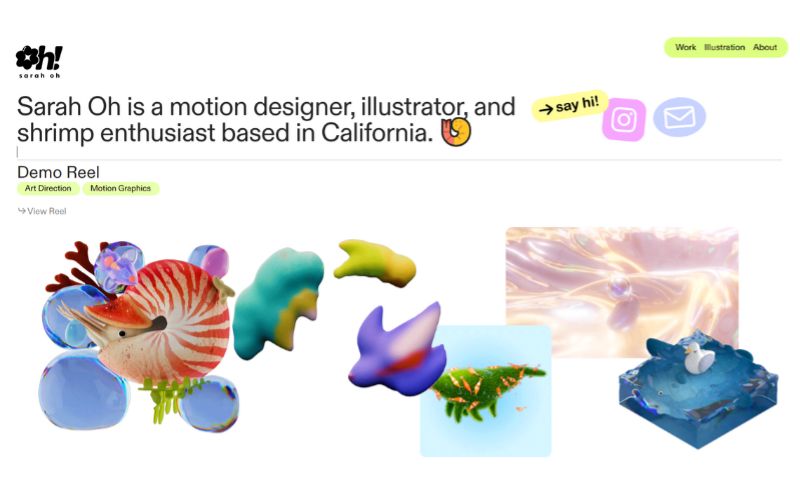
Sarah Oh
What are thebest portfolios you've consulted?
I really like Myriam Gabrielle's portfolio. She has illustrated her site entirely by hand, in an immersive atmosphere, while keeping the navigation very simple and classic.
I also liked that of Sarah 0, a Californian motion designer who describes herself as a great shrimp lover. She creates a lot of designs around marine life, which is a great promise because she's remembered as "the shrimp crea"! It's easy to understand her 3D universe, which is a little naive and zany.
As for UX/UI, I recommend you check out Laetitia Bouloque 's portfolio , which offers a real master class in project presentation !
TO LEARN MORE






No comment
Log in to post comment. Log in.